
Distilled to Evolve: How 450 Music Decisions Became Reusable Intelligence

By Ralf Hirt, CEO CovQ, New York City, United States
October 11, 2026
This CovQ Insights piece examines the creation of The Compounding Loft soundtrack. It began as a practical need for distinctive music in professional environments and became a ten-volume experiment in how human judgment and AI can work together, and what happens when the decisions from that work are allowed to compound.
Volume 1 was created for NY Tech Week and selected as one of the Top 10 events to attend by Andreessen Horowitz (a16z) out of more than 1,500 events. Across the first nine volumes, human judgment was paired with AI systems. AI expanded the search space and retained context. Human judgment set the quality threshold, made final selections, and determined sequencing. Each volume improved because it inherited prior learning.
By the end of Volume 9, 450 tracks had been selected along with thousands of decisions on selection, rejection, sequencing, and soft factors, supported by millions of model evaluations. That accumulated judgment became the real asset.
Volume 10 treated the 450 tracks as a corpus. AI inferred the underlying selection logic and generated 50 new tracks by 50 new artists, all outside the original set. The selection was kept unchanged. A process that once required substantial iterative work produced an initial volume essentially instantly and at near-zero incremental cost.
Most organizations treat high-quality decisions as outputs. This project treated them as inputs. Once enough strong judgment had been captured, the next cycle no longer had to begin from zero.
The complete collection stands at almost 50 hours of music that can be checked out on Spotify and Apple Music.
Why This Matters
Organizations generate high-quality decisions every day. Too often those decisions remain fragmented. The outcome is recorded while the reasoning and context disappear. High-quality judgment is treated as an output rather than an asset.
This experiment tested a different possibility: that high-quality human judgment, when captured with sufficient context, can become reusable intelligence. AI does not replace judgment. It makes prior judgment available for the next cycle of work. The result is a change in the economics of producing the next high-quality output. Decisions stop being disposable events and become inputs.
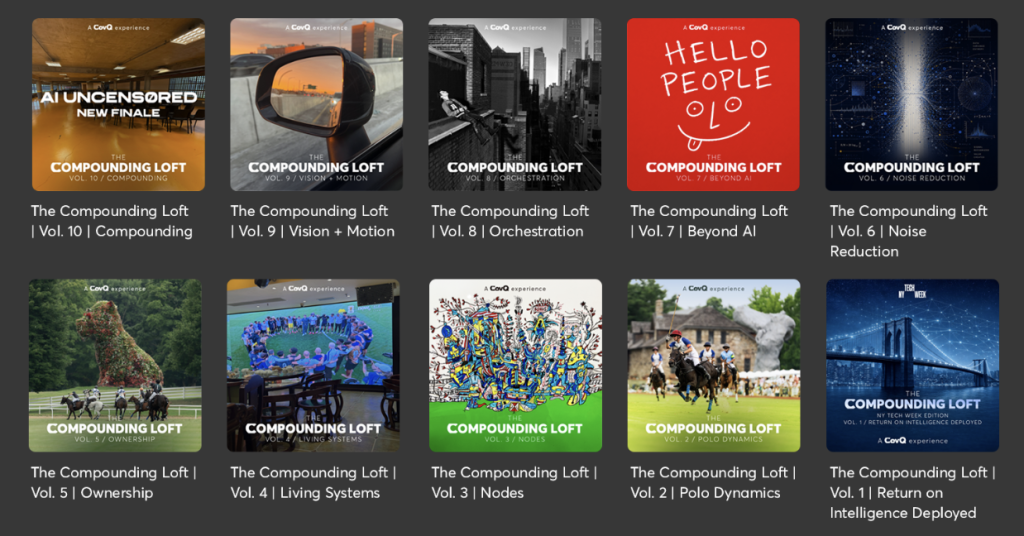
Artwork Credits: Udo Spreitzenbarth; Jason McLean; Eric Jiaju Lee: Greenwich Polo Club
Beyond Algorithmic Curation
This work differs from standard algorithmic playlist generation. Recommendation systems excel at pattern matching based on behavior, similarity, mood, and popularity. What they do not embed is intentional value logic.
Each volume carried an underlying value driver reflected in its name: Return on Intelligence, Polo Dynamics, Nodes , Living Systems, Ownership, Noise Reduction, Beyond AI, Orchestration (artwork by Udo Spreitzenbarth), Vision + Motion, and Compounding. These were principles, not mood labels. The music was selected and sequenced to support the behaviors those principles represent. The goal was an auditory environment that supports clearer thinking and more effective collaboration.
When music is optimized only for engagement, it remains entertainment. When it is built as an expression of value-creation principles, it becomes part of the operating system of a team or environment. That is the difference between curation and intentional design.
From Collaboration to Compounding
Collaboration. Human judgment provided direction while AI expanded discovery. The process was iterative.
Accumulation. Thousands of decisions created richer context. Selections, rejections, and sequencing all became informative. Each volume added intelligence, not just content.
Compounding. The accumulated intelligence itself became the input. Previous high-quality judgment was made reusable, producing a new initial output at radically lower marginal effort.
What This Demonstrates
The soundtrack is a music-based project, yet the mechanisms are not limited to music.
Organizations continually make high-value judgments. When those judgments and enough of the context around them are captured, AI can help turn them into leverage for subsequent decisions. The opportunity is not merely to insert AI into individual tasks. It is to design systems in which high-quality decisions provide context for the next cycle of work, spirit, and culture.
That requires capturing decisions with sufficient context, preserving the logic of both selections and rejections, making accumulated intelligence accessible, and continuing to apply human judgment where it creates the most value. When that happens, the work already done starts giving leverage.
Conclusion
The Compounding Loft began as a creative collaboration. Across ten volumes it produced 500 selected tracks and a far larger body of decisions and sequencing logic. The collaboration became more informed and more ambitious.
Volume 10 put the accumulated intelligence to work. The final volume of 50 tracks by 50 new artists was produced essentially instantly. The economics of generating the starting point had changed.
When high-quality decisions are treated as assets rather than disposable events, the next cycle of creation becomes operationalized and systematically evolves. Most organizations treat high-quality decisions as outputs. This project treated them as inputs, and that is the shift.